For providers · Quality and the Code
Your QMS, and the evidence already inside it
You produce Code of Practice evidence every day — an attendance follow-up, a complaint closed, a homestay visited, a concern raised. What costs you weeks is assembling it. Enrolmate keeps it assembled.
The problem is assembly, not record-keeping
Most providers keep good records. They keep them in a homestay spreadsheet, a complaints folder, a shared drive of minutes, an attendance system and someone’s inbox. None of that is organised as Code evidence, so preparing for an attestation or an external evaluation means a person spending weeks assembling what the organisation already knew.
Enrolmate holds those registers as one system, and the Code register is a view over them. Open Outcome 4 and it shows your attendance follow-ups and your raised concerns, with counts. You are not being asked to produce anything new — you are being shown that the work you already do is the evidence, and where it sits.
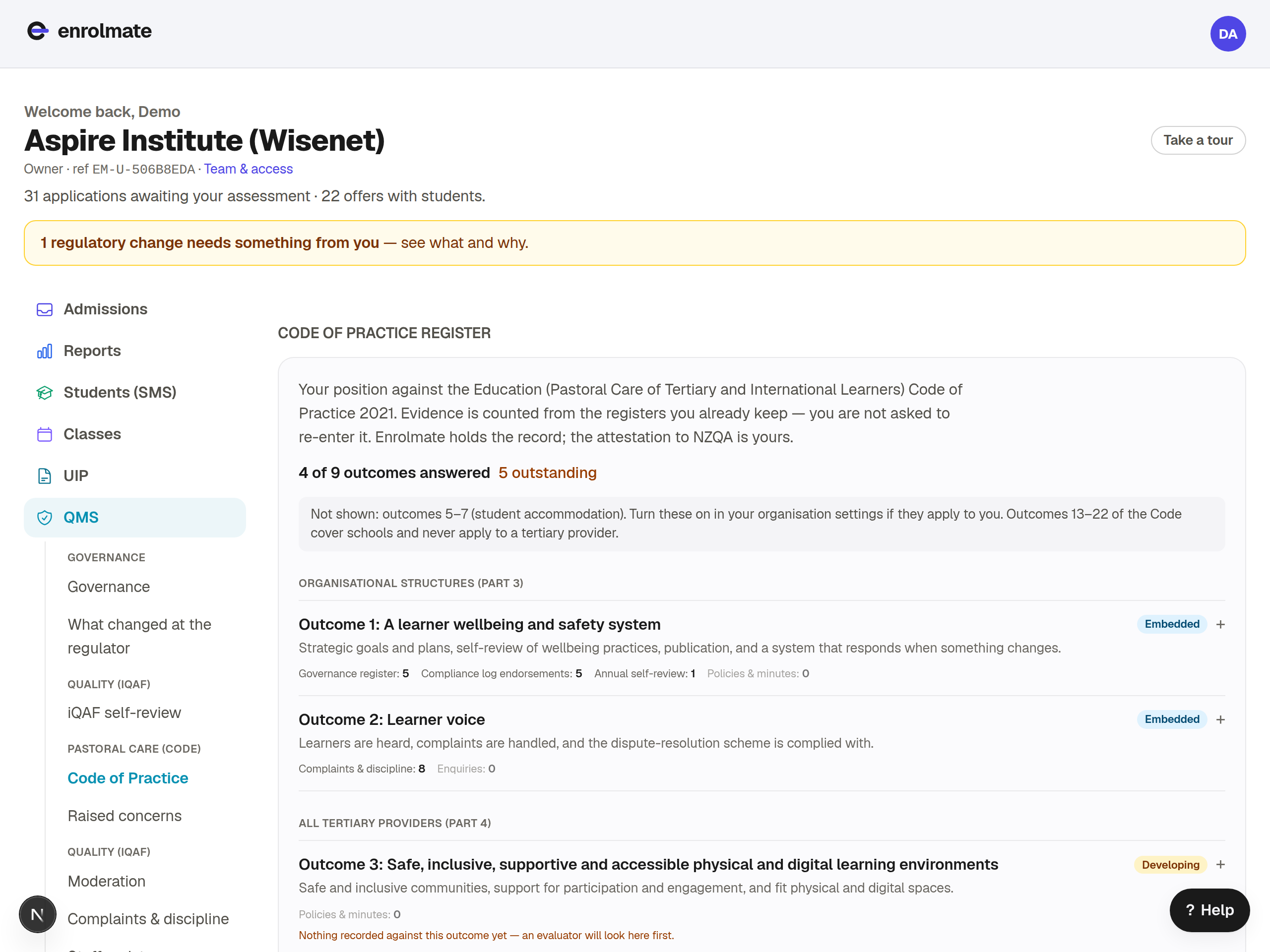
Code of Practice register
Outcomes 1–12 in one place, each showing the registers that already evidence it and how many records sit behind them. Outcomes 13–22 are for schools, and the register says so rather than asking you for them.
Raised concerns
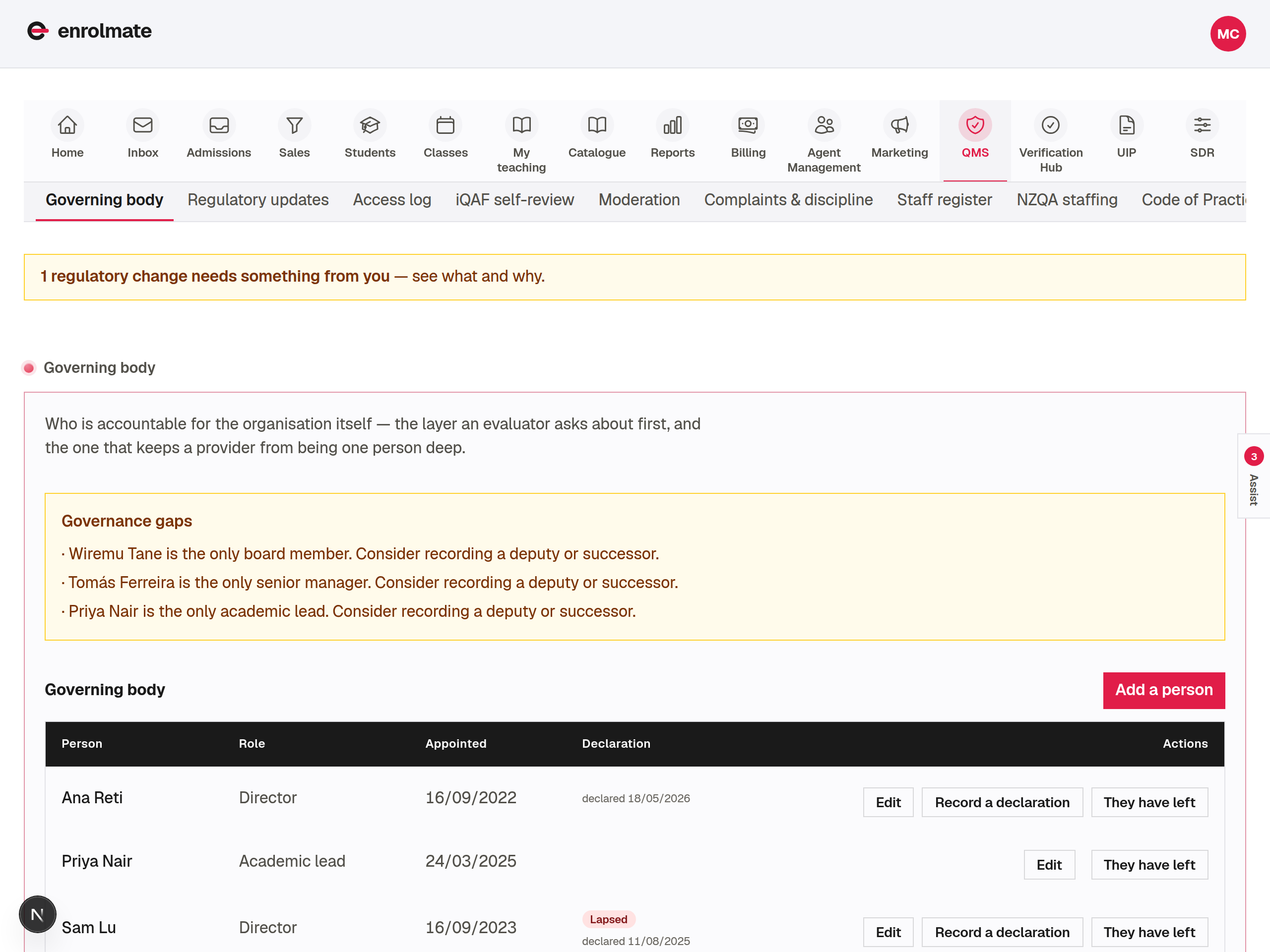
A staff member who notices something raises a concern from the learner’s record. It routes to whoever is responsible for that category, emails them, and escalates if nobody picks it up. Nobody is waiting for someone to log in.
Governance
The governing body, their fit-and-proper declarations, programme approvals and the yearly compliance log it endorses — and a warning when one person is the only person holding a responsibility.
Annual self-review
The iQAF self-review as a working document rather than a night-before exercise, with the evidence attached where you write the judgement.
Complaints & discipline
One register, two staged processes, with the chronology an evaluator reads. Closing a case takes a resolution note.
Moderation
Internal and external moderation records against the papers they belong to, so “show me your moderation” is a page rather than a search.
Staff register
Qualifications, induction, professional development and reviews. Credentials that expire — first aid, registrations — are flagged sixty days before they lapse, not after.
Pastoral care records
Accommodation and homestay including police-check and visit dates, orientation checks, visa expiry, and the attendance follow-up ladder that runs itself.
What sits behind each outcome
The Code of Practice for the Pastoral Care of Tertiary and International Learners sets outcomes a provider must meet. Outcomes 1–12 apply to tertiary providers; 13–22 apply to schools. Accommodation and international outcomes appear only if you offer accommodation or are a signatory to the international part.
| Outcome | What it covers | Evidence in Enrolmate |
|---|---|---|
| 1 | A learner wellbeing and safety system | Governance register, compliance log, self-review, policies |
| 2 | Learner voice | Complaints and discipline, enquiries |
| 3 | Safe, inclusive, supportive and accessible | Policies and minutes |
| 4 | Responsive wellbeing and safety practices | Attendance follow-ups, raised concerns |
| 5–7 | Accommodation outcomes | Accommodation and homestay register |
| 8 | Responding to concerns | Orientation checks, raised concerns |
| 9 | Prospective learners are well informed | Agent vetting, agent agreements |
| 10 | Contracts and protection of fees | Fee protection, visa expiry, issued offers |
| 11 | Orientation and ongoing support | Orientation checks |
| 12 | Safe and appropriate accommodation | Concerns, accommodation, complaints |
A concern that reaches a person
Every pastoral trigger in most systems is derived from the roll: the system notices you when you stop turning up. That ladder matters and it is not enough. A tutor who sees something in class, an accommodation coordinator who hears something from a host, an admissions officer reading a distressed email — each of them needs somewhere to put it that reaches a named human quickly.
In Enrolmate they raise a concern from the learner’s record. It routes by category to the person your organisation made responsible for it, emails them straight away, and escalates to your administrators if nobody acknowledges it inside the response window. Closing it takes a note, and nothing is ever deleted — a resolution is a recorded outcome, not a disappearance.
The notification carries no detail and does not name the learner. A concern can hold a health disclosure, and email is the least controlled surface anyone has.
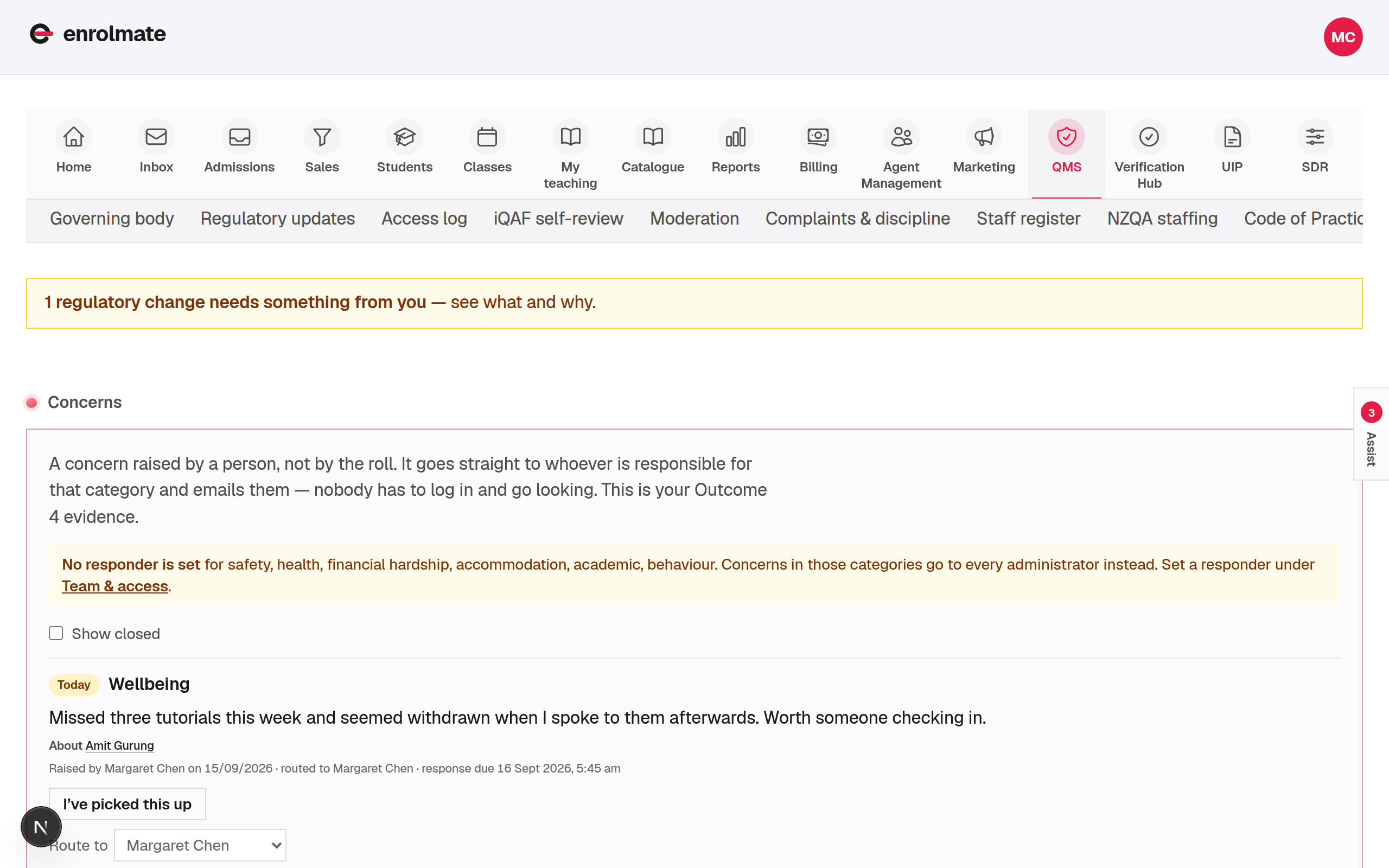
Governance, and the question nobody asks in time
The register records who governs, their fit-and-proper declarations with the date they next fall due, your programme approvals and review dates, and the compliance log your governing body signs off each year. It also tells you when a responsibility rests on exactly one person — because the reason that layer exists is continuity, and a provider usually discovers the gap at the worst possible moment.
When the rules change
When NZQA, TEC or Immigration change something, Enrolmate tells you inside the platform what changed, what it means for you, and whether we have already made the change. Most of the time there is nothing for you to do, and the point is knowing that without having to ask.
What it does not do
- It does not attest for you. Enrolmate holds the evidence and produces the summary; the attestation is yours to make, the same line we draw on the UIP return.
- It does not judge whether you meet an outcome. The status against each outcome is your judgement, as your self-review already is. We show you what is behind it, including when the answer is nothing.
- It does not decide who is a fit and proper person. That is NZQA’s test and your declaration. We record that the declaration was made and when it is next due.
- It is not a consultancy. If your QMS documentation needs restructuring to NZQA’s prescribed shape, that is work for a quality consultant. We are trying to make sure the evidence they ask you for is already there.
Preparing for an attestation or an external evaluation? We would rather build against your real evidence than a hypothetical one.
Tell us what your evaluator asked for →General information about a provider’s obligations, not legal advice. The Code of Practice is published by NZQA; confirm your specific obligations against the current version.
See it against your own outcomes, your own evidence and your own gaps
Request a demo